Cute Frog School Items Line Art: Designer Review
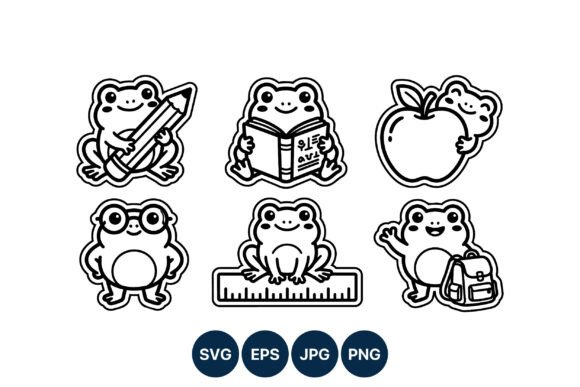
When I first opened the Cute Frog School Items Line Art set, I immediately thought of a teacher friend who had asked me weeks ago about a custom embroidered tote bag for her classroom. She wanted something playful but not babyish, something that would feel like a tiny celebration of school life without screaming cartoon chaos. This collection of six black and white frogs, each clutching a different school item, landed exactly in that sweet spot. The set belongs to the Illustrations category under Graphics, and as a line art piece, it carries a clean, approachable energy that reads well even before you start thinking about thread and fabric.
The mood here is gentle, lightly humorous, and undeniably nostalgic. One frog holds a pencil with a confident little grip. Another peers through oversized glasses, a book with visible letters open in front of it. A third cradles an apple, while a fourth balances on a ruler like it is the most natural seat in the world. The fifth waves with a backpack slung over its shoulder, and the sixth simply grins beside that unmistakable classroom fruit. Each pose feels distinct, and the set works as a cohesive unit even though the frogs are not interacting with each other directly. That is a quiet strength of this design. You can use one frog alone, pair two or three, or stitch all six in a row without losing visual harmony.
First Impression and Visual Personality
Line art designs for embroidery often walk a tricky line. Too thin, and the stitch struggles to hold on lightweight fabric. Too dense, and the charm of the sketch-like quality disappears under a heavy fill. The Cute Frog School Items Line Art strikes a balance that feels intentional. The outlines are clear, the shapes are simple but expressive, and the black and white nature of the artwork means you can approach thread color decisions with a lot of freedom. You are not locked into a palette. You can keep it monochrome for a classic look, or assign each frog a soft pastel thread for a more whimsical nursery or children's product line.
What stood out to me during my first fifteen minutes of examining the design was how the illustrator managed to give each frog a slightly different posture. The frog with the glasses has a studious tilt to its head. The one on the ruler has a playful, balancing act feel. The waving frog with the backpack has a cheerful, goodbye-for-now energy that would work beautifully on a child's backpack tag or a lunchbox patch. This is not a stiff, duplicated template. Each frog has a tiny personality, and that matters when you are stitching something that a customer will look at every day.
A Real Project Scenario: The Kindergarten Teacher Tote
Let me walk you through the exact project that made me reach for this design. A client wanted a large canvas tote bag for her daughter's kindergarten teacher, something sturdy enough to carry books and supplies, with embroidery that felt personal but not overly sentimental. She wanted the teacher's name on it, and she wanted frogs because the classroom had a frog mascot. I tested the Cute Frog School Items Line Art on a medium-weight natural canvas tote in a soft cream color. I chose three frogs: the one with the book, the one with the pencil, and the waving frog with the backpack. I arranged them in a gentle arc above the teacher's name, which I digitized separately in a simple serif font.
The stitching went smoothly. Because the design is line art, the stitch count stayed manageable, and the detail held up well on the textured canvas. I used a dark charcoal thread for the outlines, which gave the frogs a hand-sketched feel against the cream fabric. The book's visible letters stitched clearly, which I had been slightly concerned about before testing. Tiny lettering inside a design can turn into a muddled mess if the stitch density is not right, but here the letters were distinct enough to read without magnification. The glasses on the second frog had a delicate thinness that required a sharp needle and a fresh stabilizer, but the result was crisp and charming.
When the client picked up the tote, her first reaction was a quiet gasp. She traced the stitched frogs with her finger and said it looked like something from a beloved children's book. That is the kind of reaction you want from a handmade product. It moves beyond decoration into something that feels like a small piece of art.
Where This Design Shines Brightest
After testing the Cute Frog School Items Line Art on several surfaces, I can confidently say it performs best on smooth to medium-textured fabrics with a stable weave. Cotton canvas, quilting cotton, linen blends, and quality felt all produced excellent results. The design also worked well on a light sweatshirt fleece, though I had to adjust my stabilizer approach to prevent the line art from sinking into the plush surface. One unexpected win was how beautifully it stitched on a small linen pillow cover for a nursery reading nook. The frogs, arranged in a row, looked like a little parade of school supplies marching across the pillow.
For machine embroidery design enthusiasts who sell at craft fairs or run Etsy shops, this set offers versatility that many single-themed designs lack. You can use the frogs individually on:
- Custom tote bags for teachers, students, and librarians
- Sweatshirt chest embroidery for back-to-school season
- Embroidered patches for backpacks and pencil cases
- Pillow covers for classroom reading corners
- Kitchen towels for teacher appreciation gifts
- Baby onesies with a single frog as a subtle accent
- Aprons for school volunteers or cafeteria staff
- Cap embroidery for school spirit events
The line art style also makes it a strong candidate for applique adaptation. If you want to add a fabric element behind the frog outline, the shapes are clean enough to cut easily with scissors or a cutting machine. An apple-red fabric behind the frog holding the apple, or a denim scrap behind the backpack frog, could create a layered, tactile effect that elevates the finished product.
Thread Choices and Color Considerations
The black and white nature of the Cute Frog School Items Line Art graphics gives you a blank canvas for thread experimentation. I tested three approaches. First, a classic dark charcoal outline on cream fabric, which felt timeless and bookish. Second, a soft sage green thread on a natural linen background, which gave the frogs an earthy, botanical feel suitable for a nature-themed nursery. Third, I tried a bold navy outline on a white cotton apron, which read as crisp and preppy, perfect for a boutique kitchen product.
One technique I recommend is testing the design in a black and white mockup before committing to thread colors. Print the design at actual size, place it on your fabric, and step back a few feet. Does the frog's expression still read? Are the glasses distinguishable from the eyes? Does the book's lettering hold? This quick check saves you from wasting stabilizer and thread on a color choice that loses detail at viewing distance.
For dark fabric projects, you will need to think carefully. A black outline on a dark navy or charcoal sweatshirt will disappear. In those cases, consider using a lighter thread like white, cream, or a soft yellow to create a chalkboard-style effect. The design's line art nature actually lends itself well to this inverted approach, resembling a chalk drawing on a dark surface. I stitched a single frog in white thread on a dark green baby blanket, and the result was delicate and dreamy.
Where to Proceed with Extra Caution
No design works perfectly everywhere, and the Cute Frog School Items Line Art has situations where you should pause and test before committing to a client order or a batch production run. The line art style means the stitch width on certain details can be quite narrow. On stretchy fabric like jersey or ribbed knit, those fine lines can distort if the fabric shifts during stitching. Use a strong cutaway stabilizer and consider a light spray adhesive to hold the fabric in place. I would not recommend this design for a thin, slinky t-shirt without significant stabilization testing first.
Small hoop sizes also deserve attention. If you try to shrink the entire set of six frogs into a tiny space, the fine details like the glasses, the book letters, and the backpack straps will start to close up. You need enough room for the needle to travel and create distinct shapes. I found the sweet spot for a single frog was around two to three inches in height. For a group of three frogs, I used a larger hoop that allowed at least four to five inches of width. Check your hoop size and the design dimensions before purchasing, and be realistic about what your machine can handle with clarity.
Curved surfaces like caps and hats can be tricky because the frogs are drawn with a distinct horizontal orientation. The ruler-sitting frog and the waving frog both have strong horizontal lines that can look warped on a curved cap crown unless you adjust the placement and stabilize the cap carefully. It is not impossible, but it requires more finesse than a flat tote bag project.
Also, products that face frequent washing, such as children's sweatshirts or lunch bags, need a thread that holds up to repeated cycles. The fine line art stitches can abrade over time if you use a lower-quality thread or skip the protective pressing step after embroidery. I always press a light interfacing or a soft backing over the stitched area on the reverse side to protect the threads from friction during washing.
Business and Branding Value for Sellers
From a craft business perspective, the Cute Frog School Items Line Art offers something that highly specific, color-heavy designs sometimes lack: broad appeal with a distinctive personality. A customer shopping for a teacher gift does not want a generic apple or a plain pencil. They want something that feels thoughtful and slightly unique. These frogs deliver that. The set can be marketed as a back-to-school collection, a teacher appreciation line, a library-themed product, or even a nursery decor item for parents who love a literary, whimsical aesthetic.
For Etsy sellers and small shop owners, the design's versatility supports multiple listing angles. You can offer a personalized tote with one frog and a name. You can create a set of six embroidered patches, one for each frog. You can stitch a full row of all six frogs on a pillow cover and list it as a classroom decor piece. You can even use the design as a printable mockup element for your shop listings, showing customers how the embroidery would look on different products without stitching every single variation.
The giftability factor is high. Frogs are a beloved animal for children's products, and the school theme ties directly to major gifting seasons: back-to-school in August and September, Teacher Appreciation Week in May, and end-of-year graduations. A thoughtfully embroidered item with these frogs feels more personal than a mug or a candle, and customers are often willing to pay a premium for that handmade touch.
Practical Embroidery Designer Notes
Before you stitch the Cute Frog School Items Line Art for a paying client or list it in your shop, here is a focused checklist based on my testing process:
- Test on scrap fabric first. Always. I used a piece of the same canvas I planned for the final tote, and it revealed a slight tension issue I fixed before the real run.
- Check thread color contrast. Hold your chosen thread against the fabric under natural light. The line art needs to stand out clearly.
- Review stitch density. If the digitized file has overly dense areas, the fine details may pucker. Run a test and inspect the back of the fabric.
- Confirm hoop size. Measure the design dimensions and ensure your hoop can accommodate the placement you want, especially for multi-frog arrangements.
- Inspect small details. The glasses, the book letters, and the backpack straps are the most delicate parts. Look at them closely after stitching.
- Test on light and dark fabric. The design may need different thread colors or an outline adjustment to read well on both backgrounds.
- Use proper stabilizer. For line art, a medium-weight cutaway stabilizer generally works best. For stretchy fabrics, add a temporary spray adhesive.
- Check licensing terms. Before selling finished products or digital embroidery files, confirm that the design license allows commercial use. The Graphics product type and Illustrations category may have specific usage terms you need to review.
Final Thoughts from the Stitching Table
The Cute Frog School Items Line Art earned a permanent spot in my design library, not because it is flashy or trend-driven, but because it is genuinely useful and consistently charming. It solves a real problem for embroidery designers who need a school-themed design that does not feel mass-produced or overly saccharine. The six frogs work as a set, as singles, or in custom groupings, giving you enough creative range to serve multiple customer requests without buying additional designs.
For the handmade product maker who wants to offer something that feels personal and lovingly crafted, this design delivers. It stitches cleanly, adapts to different color schemes, and brings a quiet, storybook quality to whatever surface it touches. Whether you are making a teacher tote, a baby blanket, a set of kitchen towels, or a boutique apron, these little frogs hold their own with grace and just the right amount of whimsy.