A Designer’s Take on the Teacher Appreciation Floral Globe
As someone who stitches designs for clients every day, my first question about any new file isn’t “What is it?” but “How will it stitch?” Let’s walk through that process with the Teacher Appreciation Floral Globe PNG, viewing it purely as a potential embroidery project.
The Design’s First Impression: A Warm, Gift-Ready Mood
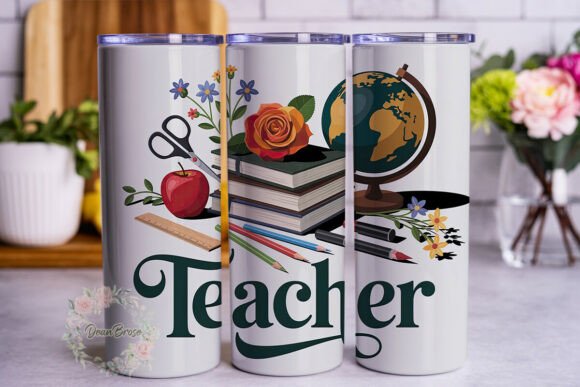
Opening this design, the mood is immediately clear: warm, appreciative, and crafted. The circular globe motif creates a contained, focal point feel—perfect for an embroidered patch or a centered applique. The intertwining florals around the “Teacher” lettering soften the statement, giving it a handmade, personal touch rather than a stark slogan. This visual personality leans toward gifts and personalized products. It feels like something meant to be stitched onto a tote bag for a favorite educator or the front of a cozy sweatshirt.
Where This Embroidery Design Naturally Belongs
In practical use, this design fits a specific niche: products meant to convey gratitude. Imagine you’re preparing for a back-to-school craft fair or an Etsy shop update focusing on educator gifts. This file would be a strong candidate for a curated collection. Its size, at roughly 9.3″ by 8.2″, suggests it’s suited for larger hoops, making it ideal for statement pieces.
Think of an embroidered pillow cover for a teacher’s lounge, a decorative apron, or a large patch on a canvas bag. The high-resolution detail promises clean curves in the floral elements, which should translate well into satin stitch borders and fill stitch areas, provided the embroidery file itself is well-digitized. The “Teacher” text is central and sizable, avoiding the pitfalls of tiny lettering that can blur or break in stitching.
Real-Life Scenario: Crafting a Custom Embroidered Tote
Let’s picture a real project. You have a client who wants a custom tote bag for their child’s kindergarten teacher. You load this design. The circular layout means it will sit nicely on the flat front panel of the bag. The floral frame adds a decorative accent without overwhelming the message. After stitching, you’re evaluating not just the look, but the feel. Does the stitch density make the fabric too stiff? On a tote, some stiffness in the design area is acceptable, even adding to the product’s perceived quality. The positive, warm theme directly enhances the gift’s appeal and, frankly, the customer’s trust in your curation skills.
Performance Across Different Embroidery Situations
This design’s strength is in larger, flat applications. On sweatshirts or t-shirts, position it centrally for a classic look. For baby clothes or nursery decor, it’s likely too large, but a scaled-down version could work if the file permits. On caps or curved surfaces, a full 9-inch diameter might be challenging; the curvature could distort the globe shape. It shines on tea towels, pillow covers, and blankets—home goods where its appreciative message becomes part of the decor.
For commercial embroidery projects, like a small batch of aprons for a school fundraiser, this design offers clear recognition and professionalism. It’s not overly generic; the floral elements provide a crafted touch that elevates it above basic text. For a craft business, it’s a ready-made asset for holiday gifts (end-of-year teacher appreciation) or personalized products where you can pair it with a name.
Careful Considerations Before Hooping Up
Any experienced designer knows to spot potential trouble areas. Here’s where I’d proceed with caution. First, the detail in the floral frame. If the embroidery file has very fine lines, they might require precise thread color contrast against the background fabric. Stitching this on dark fabric? You’ll need to plan your thread palette carefully to maintain clarity.
Small hoop sizes are not this design’s friend. Trying to cram it into a small area will compress the details and likely increase stitch density, which could be problematic on thin or stretchy fabrics like certain t-shirt materials. Always use a proper stabilizer here. Textured fabrics, like some blankets, might cause the fill stitches in the globe background to look uneven.
The design’s scale also means it’s a commitment on a garment. On layered garments like hoodies, check the fabric thickness. Dense stitch areas could create a heavy, uncomfortable patch if not managed. And for products needing frequent washing, like kitchen towels, ensure your stitch settings are secure to prevent premature wear on the detailed edges.
Affecting Your Business and Craft
Using a design like this impacts more than just the stitch. It affects your product’s visual appeal and value. A well-executed version of this on a high-quality tote bag feels premium—a true handmade presentation. It supports brand consistency if your shop specializes in gratitude or educator-themed items. Its inherent giftability is a sales advantage. For digital product sellers offering printable mockups, this PNG’s clean, high-resolution background makes it a strong design asset for creating compelling previews.
Practical Notes from the Embroidery Desk
Before running this for a client, my checklist would be:
- Test it on scrap fabric first. Always. See how the florals actually stitch.
- Check thread color contrast, especially if deviating from a likely white/light background.
- Review the stitch density in your software if possible. Is it appropriate for your target fabric?
- Confirm your hoop size can accommodate the full dimensions without compromise.
- Inspect the small details in the floral accents on your test piece.
- Test the design in black and white mockups to gauge its form without color.
- Compare how it looks conceptually on both light and dark fabric backgrounds.
- Use a stabilizer suited to your base material—don’t skip this step.
- Critically, check whether the design’s licensing terms work for your purpose. Is it for personal use only, or can you use it for commercial embroidery projects and sell the finished products? This information is not provided here, so you must confirm it before selling any embroidered tote bags, patches, or apparel.
Embroidery is a translation process: from digital file to physical thread. The Teacher Appreciation Floral Globe PNG presents a charming, thematically strong source image. Its success as a machine embroidery design hinges on that translation—the quality of the embroidery file itself, your machine settings, and your thoughtful application. When matched with the right project, like that custom teacher tote, it has the potential to stitch up into a product that feels both professionally made and personally meaningful.